
WE ACCEPT UNITED HEALTHCARE GLOBAL INSURANCE

Bedside to Bedside
Medical Evacuation From a Local Hospital to your Home Hospital

All Inclusive
No Hidden Charges, our written quote is all Inclusive.We Accept Most Insurance.

Top Quality
Latest Medical Equipment and Highly trained medical staff. Air Ambulance Worldwide Experts.
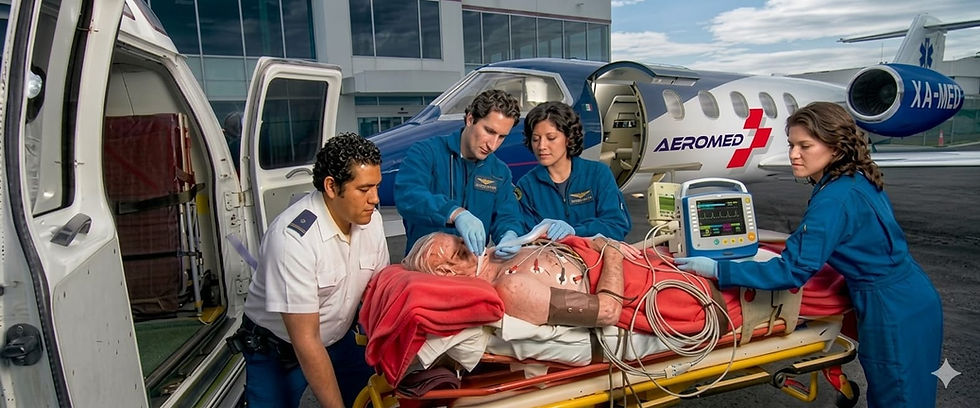
UNITED HEALTHCARE GLOBAL does not operate its own air ambulance service; instead, medical flights are carried out by third-party providers like Aeromed, which is a fully licensed and insured air ambulance service.
Air ambulance Transport,Medical evacuation, often referred to as medevac or medivac, is only required when a medical condition cannot be adequately treated in the current location. It involves moving a patient to another location with a higher standard of care. Medical evacuation may not involve moving the patient to their home country; it may be more appropriate to bring the patient to a location with quality medical care within the same region.
Medical evacuation can be as simple as a ground ambulance ride or as complicated as an air ambulance moving a patient from one country to another. Air ambulances are basically flying intensive care units with specially trained medical staff.
Air ambulance dispatch should be based on the patient´s specific needs rather than restrictive policies. Avoid unnecessary bureaucracy and poor decisions made by untrained coordinators who merely follow a flowchart.
Contact us immediately to confirm eligibility benefits, as most transports occur within 12 hours once benefits are verified.
Most members have some level of air ambulance coverage.
Our 24/7 care coordinators will determine coverage and benefits within one hour of your initial call.
Please note, Medicaid members of United Healthcare (domestic US) are not covered for care outside the U.S
If you're planning to travel internationally with one of these plans, consider purchasing our air ambulance membership for additional health coverage.
Air ambulance costs can vary greatly on flight distance, provider location, and your insurance coverage. Without insurance, expenses can be exorbitant, potentially ranging from tens of thousands to hundreds of thousands dollars for a single flight.
It's crucial to contact us right away to assess your insurance coverage.
We will review your policy to clarify your specific air ambulance benefits and any out-of-pocket costs.
Factors influencing costs include:
-
Distance: Longer distances generally result in higher costs.
-
Provider: Different air ambulance companies have varying pricing structures Aeromed strives to keep rates competitive and minimize out-of-pocket expenses.
-
Insurance Coverage: For UNITED HEALTHCARE GLOBAL patients, we recommend us immediately. Our insurance specialists will review your plan and clarify the terms regarding air transport, as coverage can vary. We will submit a detailed bill for air ambulance services and diligently follow up with the united Healthcare until the claim is resolved.
UTILIZATION GUIDELINES
I. Procedure: Ground and Air Ambulance and Non-Emergency Medical Transportation
A. United Healthcare Global covers emergency ambulance, ground, air, and water transport services.
Coverage for ambulance transport is limited to medically necessary ambulance transportation
services and supplies of a licensed ground or air ambulance, when the member’s medical condition
requires basic life support (BLS), advanced life support (ALS), or critical care life support
capabilities of an ambulance to a hospital facility or inter-hospital facilities.
1. Coverage is also provided for emergent, medically necessary transportation due to a 911 call.
2. Ambulance services are covered under the emergency service provision specified in each contract.
II. Clinical Guidelines for Ground Ambulance
A. Emergency Ambulance Transport Medical Necessity
An Ambulance transport is clinically indicated when there is an emergency medical circumstance such
that the use of any other method of transportation is contraindicated and would endanger the
member’s health, as attributed to any of the following:
1. Needs to be transported in an emergency, such as an accident, injury, or acute illness, or
2. Needs to be restrained to prevent injury to themselves or others; or
3. Is unconscious or in shock; or
a. Requires high flow rate oxygen of 2 liters or more or other emergency treatment which is not
available during other types of transport to the nearest appropriate facility; or
b. Exhibits signs and symptoms of acute respiratory distress or cardiac distress such as shortness of breath or chest pain; or
c. Exhibits signs and symptoms that indicate the possibility of acute stroke; or
d. Needs to remain immobile because of a fracture that had not been set, or manifesting signsand symptoms of a potential fracture and /or dislocation; or
e. Is experiencing severe hemorrhage; or
f. When a member requires care at an alternate acute care Medical Facility, including further care coordination, as determined by the treating provider.
III. Clinical Guidelines for Air Ambulance
Emergency air transport is clinically indicated when the member’s condition is such that the time needed
to transport a member by ground, or the instability of transportation by ground, poses a threat to the
member’s survival or seriously endangers the member’s health.
1 Air ambulance transportation services,
either by means of a helicopter or fixed wing aircraft, is medically necessary on any the following:
A. Community to Hospital Air Transport
An air transport from the community to a hospital is clinically indicated if all of the following criteria
are met:
1. When the member’s medical condition requires immediate and rapid ambulance transportation
that cannot be provided by ground ambulance due to either of the following:
a. The point of pickup is inaccessible by ground vehicle (this condition could be met in Hawaii,
Alaska, and in other remote or sparsely populated areas of the continental United States); or
b. Great distances or other obstacles prevent the timely transport of the member to the
nearest hospital with appropriate facilities; and
2. The member must be alive at the time of the air ambulance’s departure from their origination site
except when a member is pronounced dead before being loaded onto the ambulance for
transport (either before or after the ambulance arrives on the scene) and meets all of the
following:
a. The air ambulance service would otherwise have been medically necessary; and
b. The pronouncement of death is made by an individual authorized under state law to make
such pronouncements.
3. As a general guideline, air transportation is appropriate when ground ambulance is predicted to
exceed 30-60 minutes to transport a member whose medical condition requires immediate and
rapid transport due to the nature and/or severity of the illness/injury. However, differing
statewide Emergency Medical Services (EMS) systems determine the amount and level of basic
and advanced life support ground transportation available. and
4. The aircraft and crew must meet the ambulance requirements listed in Sections V, VI and VII.
Ambulance Vehicle and Crew Requirements; and
5. All cardiac air ambulance transports require the review and authorization of the on-duty
Emergency Care Management (ECM) Physician. Cardiac conditions, requiring medically
necessary urgent/emergent air transport services can be authorized by referring Physicians in
conjunction with Cardiologists.
B. Hospital to Hospital Air Transport
An air ambulance transport from one hospital to another hospital is clinically indicated if all of the
following criteria are met:
1. If transportation by ground ambulance would endanger the member’s health and the
transferring hospital does not have adequate facilities to provide the medical services needed
by the member; and
2. If the hospital to which the member is transferred is the nearest one with appropriate facilities
or is a contracted hospital for special services.
a. Examples of specialized medical services not available at all facilities may include but not
limited to burn care, cardiac care, neurosurgical care, neurointerventional care, trauma
care, and critical care.
VI. Exclusions / Requirements for Air Ambulance
An air ambulance transport is considered NOT medically necessary in the presence of any of the
following:
A. When the air ambulance dispatcher is notified of the member’s death and there was a reasonable
opportunity to notify the pilot to abort the flight. This includes when an air ambulance has been
cleared for takeoff or taxied but has not actually lifted off; or
B. Services that are considered non-critical care. Air transport services are not covered for transport
to a facility that is not an acute care hospital, such as a nursing facility, physician’s office, or a
member’s home; or
C. When the air ambulance transport is from a hospital capable of treating the member to another
hospital because the member or the member’s family prefer a specific hospital or physician; or
D. Cardiac conditions without cardiogenic shock require review and authorization by a physician
provider.
VII. Air and Ground Ambulance Vehicle and Crew Requirements
Ambulance transport must comply with all of the following requirements:
A. Any vehicle or aircraft used as an ambulance must be designed and equipped to respond to
medical emergencies and, in non-emergency situations, be capable of transporting members with
acute medical conditions; and
B. The vehicle or aircraft must comply with state or local laws governing the licensing and certification
of an emergency medical transportation vehicle; and
C. Basic Life Support (BLS) ambulances must be staffed by at least two people, at least one of whom
must be certified as an emergency medical technician (EMT) by the State or local authority where
the services are being furnished and be legally authorized to operate all lifesaving and life
sustaining equipment on board the vehicle; or
D. Advanced Life Support (ALS) vehicles must be staffed by at least two people, at least one of whom
must be certified by the State or local authority as an EMT-Intermediate or an EMT-Paramedic.