
Medical repatriation for Canadians hospitalized abroad
A Canadian is in hospital in another country and the family is trying to work out how to get them home. The hard part is rarely the medicine. It is discovering how little the provincial plan pays once you leave Canada, and how fast the gap grows.
What your provincial plan actually pays outside Canada
Far less than most people assume, and in one province nothing at all.
British Columbia. The Medical Services Plan limits out-of-country hospital coverage to a maximum of CAD $75 per day. It also states plainly that no provincial assistance is provided for ambulance services outside B.C. An intensive care bed in the United States can run several thousand dollars a day, so the $75 is close to symbolic.
Ontario. OHIP ended out-of-country emergency coverage in January 2020. Before that it paid up to $400 a day for inpatient care and $50 a day for outpatient care, which was already a fraction of real cost. Today an Ontario resident treated abroad is, for practical purposes, uninsured by the province.
The other provinces sit between those two positions, and every one of them stops well short of the actual bill. None of them pays to bring you home.
The repatriation gap
This is the part that catches families. Provincial coverage is written around treatment, not transport. Even where a plan reimburses a portion of the hospital stay, it does not fund an air ambulance or a medical escort to bring the patient back to Canada. That cost sits with the traveller, the travel insurer, or the family.
Travel insurance: read the evacuation clause, not the headline
A travel policy may cover emergency medical expenses, emergency medical evacuation, or both, and they are not the same thing. Evacuation cover is the one that moves the patient. Two details decide how useful it is. First, the insurer usually reserves the right to choose the destination, and the nearest adequate facility is not always home. Second, the transport nearly always has to be authorized in advance; a flight booked first and claimed afterwards is the most common reason a repatriation claim is refused.
What the insurer needs before it will authorize
A statement from the treating physician on why commercial travel without medical support is not appropriate.
A current clinical summary from the hospital holding the patient.
Written acceptance from the receiving hospital in Canada.
The flight plan and medical crew configuration, so the insurer can price what it is approving.
We put that package together as a matter of routine. For a family doing it for the first time, in a second language, from a different time zone, it is where days get lost.
Snowbirds
Long winter stays in Mexico, Arizona, Florida and Texas are where we see most Canadian cases, and the pattern repeats: a fall, a cardiac event or a stroke, a hospital that stabilises the patient, and then a discharge plan that requires a flight nobody budgeted for. If you are wintering south, check the evacuation clause before you travel rather than after.
If there is no coverage
Many of the transports we fly are paid privately. We quote those as a single fixed all-inclusive price agreed in writing before departure, covering aircraft, crew, medical team, equipment and ground ambulance at both ends, with no post-flight invoice for extras. Where a medical escort on a scheduled flight is clinically adequate, we will say so, because it costs considerably less than a dedicated aircraft.
Talk to us first
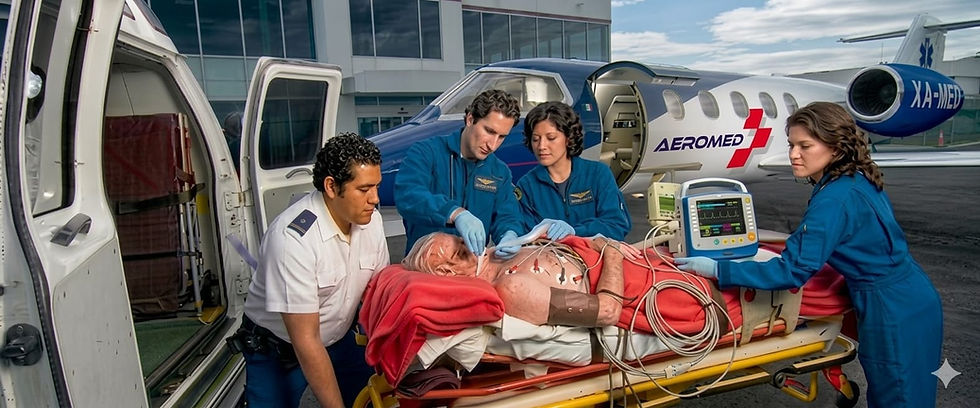
Aeromed Air Rescue operates from Houston, Texas, with medically configured aircraft and critical care crews, covering the corridor between Canada, the United States, Mexico, Central America and the Caribbean. We answer 24 hours a day. Call +1 832 417-8569 or write to ops@aeromedairrescue.com.
If the patient is American, the coverage picture differs and we cover it separately on medical repatriation for Americans hospitalized abroad.