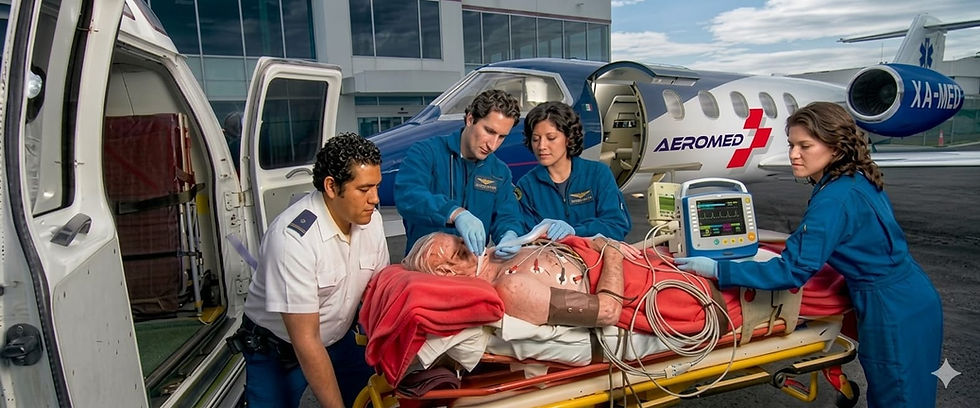

What to Expect During a Bed-to-Bed Air Medical Transfer


When a patient requires urgent medical attention that cannot be provided locally, a bed-to-bed air medical transfer becomes a critical option. These transfers ensure that patients are safely moved from one medical facility to another while receiving continuous, high-quality care. Understanding the process helps families, healthcare providers, and patients make informed decisions.
What is a bed-to-bed air medical transfer?
A bed-to-bed air medical transfer refers to the coordinated movement of a patient from one hospital bed to another, typically involving specialized air medical transport services. Unlike standard patient transport, these transfers include medically trained staff, emergency equipment, and continuous monitoring.
Key benefits include:
Rapid transportation to advanced care facilities
Continuous medical monitoring during transit
Access to specialized medical interventions mid-flight
Providers like Aeromed Air Rescue and other international air ambulance services offer comprehensive solutions for critically ill or injured patients, regardless of geographic location.
What is the role of medical professionals in air medical transfers?
During the transfer, medical professionals, including critical care nurses and paramedics, assess the patient’s condition, administer medications, and operate life-support equipment. Flight coordinators work alongside these teams to determine the most suitable air medical transport service based on distance, weather, and the patient’s medical needs.
A structured evaluation includes:
Factor | Consideration |
Patient Condition | Vital signs, stability, special care requirements |
Distance | Proximity to destination hospital |
Aircraft Type | Fixed-wing vs. rotary-wing based on travel needs |
Logistics | Ground transport coordination, airport accessibility |
This ensures patients receive uninterrupted care from departure to arrival.
Which aircraft are used for short and long-distance air medical transfers?
Helicopters are ideal for short-range, rapid hospital transfers, while fixed-wing jets handle long-distance or international flights. Both provide critical care during transit, ensuring patients receive timely, specialized medical attention wherever needed.
Modern air ambulance services use two main types of aircraft:
Helicopters (Rotary-Wing Aircraft): Ideal for short distances and rapid hospital-to-hospital transfers, especially in urban areas.
Jets (Fixed-Wing Aircraft): Preferred for long-distance or international transfers due to speed, comfort, and medical equipment capacity.
Both aircraft types are critical in global medical evacuation scenarios, allowing patients to reach specialized facilities efficiently.
Aircraft Type | Best Use Case | Average Speed |
Helicopter | Short-range, urban | 120–150 mph |
Fixed-wing Jet | Long-distance, international | 450–600 mph |
How should patients and families prepare for a bed-to-bed air medical transfer?
Ensure a thorough medical assessment, verify insurance coverage, and coordinate flight logistics. Prepare patient records, plan ground transport to and from airports, and communicate with medical teams to ensure a safe, smooth, and timely air medical transfer.
Preparation begins with medical and logistical coordination:
Medical Assessment: Doctors and nurses evaluate whether the patient is stable for transport.
Insurance Verification: Most air ambulance services, including international air ambulance providers, work closely with insurers. Proper verification ensures coverage and reduces out-of-pocket expenses.
Flight Planning: Flight coordinators choose the aircraft, route, and medical crew.
Ground Transport Coordination: Ambulances may transport the patient from the hospital to the aircraft and from the arrival airport to the destination hospital.
Insurance coverage can greatly affect transfer decisions. Families are encouraged to confirm whether insurance use applies for international or long-distance medical flights.
How is critical care maintained during a flight in a medical aircraft?
During the transfer, patients are continuously monitored by a medical team. Standard procedures include:
Vital signs monitoring
Oxygen therapy and ventilator support if needed
Medication administration
Emergency interventions in case of complications
The cabin is equipped similarly to an ICU, ensuring patients receive specialized care equivalent to a hospital environment. Flight crews maintain communication with the receiving facility to prepare for immediate care upon landing.
What should healthcare providers know when arranging international air medical transport?
For patients needing transfers across borders, international air ambulance services handle additional complexities:
Customs and immigration clearance for the patient and crew
Coordination with hospitals and consulates
Compliance with local and international aviation regulations
These services are essential for global medical evacuation, ensuring timely access to life-saving treatment in critical situations.
What factors affect insurance coverage for air medical transfers?
Insurance plays a major role in air medical transfers. Many plans cover air ambulance services, but coverage varies depending on:
Type of transport (domestic vs. international)
Medical necessity
Provider accreditation
Families should always confirm coverage and clarify whether costs will be billed to insurance or out-of-pocket.
Advantages of Bed-to-Bed Transfers
Patients receive continuous medical care, rapid access to specialized facilities, and reduced travel stress. Expert medical teams manage every step, ensuring safety, comfort, and seamless coordination from one hospital bed to another, even internationally.
Continuity of Care: Patients receive constant medical supervision.
Reduced Travel Stress: Medical teams manage all logistics, reducing family anxiety.
Rapid Access to Specialized Care: Patients can reach hospitals with specialized facilities quickly.
Global Reach: International air ambulance services can safely evacuate patients anywhere in the world.
Tips for Families
Stay informed by asking about the transfer process, crew qualifications, and equipment. Coordinate with insurance for coverage, prepare complete medical records, and maintain communication with flight coordinators to receive real-time updates on the patient’s condition during the transfer
Ask Questions: Understand the transport process, crew qualifications, and monitoring equipment.
Coordinate with Insurance: Ensure all costs are verified before departure.
Prepare Patient Records: Bring comprehensive medical documentation to support treatment during transfer.
Stay in Communication: Flight coordinators typically provide real-time updates on patient status.
Air Medical Care and Safety
A bed-to-bed air medical transfer is a lifesaving service that combines advanced medical care with specialized transportation logistics. From the initial medical assessment to arrival at the destination hospital, patients benefit from continuous monitoring, highly trained medical staff, and carefully selected aircraft.
Whether domestic or international, using air medical transport services ensures patients reach critical care facilities safely. Families and healthcare providers who understand the process can make informed decisions, maximize insurance coverage, and reduce stress during emergencies. Providers like Aeromed Air Rescue set industry standards for quality, safety, and efficiency in global medical evacuation.
FAQs
What is a bed-to-bed air medical transfer?
A bed-to-bed air medical transfer is a complete patient transport service where medical teams move a patient directly from one hospital bed to another using an air ambulance.
How does bed-to-bed air ambulance transport work?
The process includes ground ambulance pickup from the hospital, transfer to the aircraft, medical care during the flight, and ground transport to the destination hospital.
Who needs a bed-to-bed air medical transfer?
Patients who require long-distance hospital transfers, specialized treatment in another city or country, or critical care transport often need bed-to-bed air medical transfers.
What medical care is provided during air medical transport?
Air medical transport teams provide ICU-level care including monitoring vital signs, ventilator support, medication administration, and continuous medical supervision.
Are bed-to-bed air ambulance services available internationally?
Yes. Many air ambulance providers offer international patient transfers, allowing patients to travel safely between countries for medical treatment or repatriation.
How long does a bed-to-bed medical transfer take?
The duration depends on the distance between hospitals, but air ambulance flights significantly reduce travel time compared to ground transport.